

SC: Revenue Records Don’t Grant Ownership or Title Rights
 Copy Link
 Share
Share Save
Save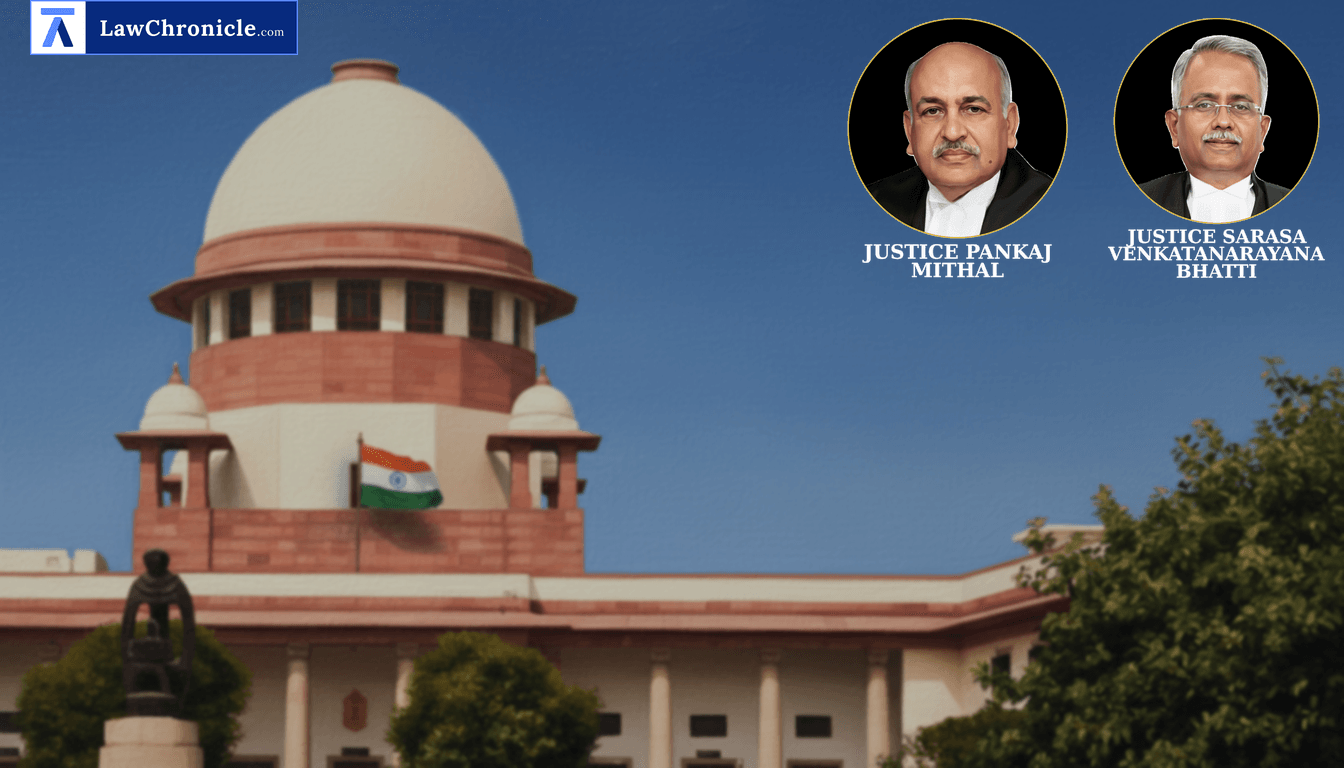
The Supreme Court of India ruled that a revenue record is not a document of title and does not confer any ownership or title upon the person whose name appears in it. A Bench comprising Justices S.V.N. Bhatti and Pankaj Mithal heard an appeal challenging an order of the Joint Collector and the validity of a 1950 notification proposing the reservation of land as forest. The Court examined whether revenue entries could sustain a claim of title when the State sought to treat the land as forest.
The Court dismissed the appeal and held that the writ forum could not be expanded to adjudicate a disputed title when the material on record was truncated, contradictory and devoid of primary title documents. The Court particularly relied upon prior precedents to underscore that entries in revenue records served a fiscal purpose primarily and did not of themselves confer title.
The Court, in its reasoning, observed: "In our view, the learned Single Judge expanded the scope of judicial review, and for all purposes declared the claim of the Appellants as maintainable for the title to the Subject Matter. Such a course is unavailable, and the same has been rectified through the impugned judgment. Having noted the Claim and the documents on which the Appellants are relying, we are of the view that the life of the litigation need not be extended by leaving open a few non-existing issues for decision, either by an Authority or a Court."
The Court explained that it had relied on a line of decisions including Suraj Bhan v. Financial Commissioner ( "(2007) 6 SCC 186": 2007 CaseBase(SC) 789), Jitendra Singh v. State of MP, Bhimabai Mahadeo Kambekar v. Arthur Import & Export Co. ( "(2019) 3 SCC 191": 2019 CaseBase(SC) 1624), Sawarni v. Inder Kaur, Gurunath Manohar Pavaskar v. Nagesh Siddappa Navalgund ( "(2007) 13 SCC 565": 2007 CaseBase(SC) 728), State of A.P. v. Star Bone Mill & Fertiliser Co., Balwant Singh v. Daulat Singh (D) By Lrs., Guru Amarjit Singh v. Rattan Chand ( "(1993) 4 SCC 349": 1993 CaseBase(SC) 857), Bhimeshwara Swami Varu Temple v. Pedapudi Krishna Murthi, Baleshwar Tewari v. Sheo Jatan Tiwary, State of Punjab v. Sadhu Ram ( "(1997) 9 SCC 544": 1996 CaseBase(SC) 359) and Sohan Lal v. Union of India and another ( "(1957) 1 SCC 439": 1957 CaseBase(SC) 96) to summarize legal propositions that revenue entries were not documents of title, could at best raise a presumption of possession in limited circumstances, and could not substitute for primary title deeds. The Court also referred to the limits of relief under Article 226 of the Constitution of India, 1950 when serious disputes of fact and title were involved.
Background:
The dispute arose from a 1950 Gazette proposal to include an extent of 787 acres in a reserve forest which allegedly encompassed the Appellants’ patta lands. The Appellants claimed title through earlier pattas and reliance on revenue records such as Faisal Patti, Vasool Baqi and Pahanies, and sought quashing of the Joint Collector’s order of 19.05.2003 and exclusion of the subject land from the proposed reservation. A Single Judge allowed the writ petition in 2012, set aside the Joint Collector’s order and declared the reservation proceedings to be ultra vires; the Single Judge’s order concluded with: "In the result, the writ petition is allowed making Rule Nisi absolute quashing the impugned order dated 19-5-2003 ... and declaring that the proceedings relating to reserving Ac. 600-00 in S.No.81 ... are ultra vires and non est in the of law. No costs." The Division Bench reversed that view, holding that a notification was not automatically vitiated for having been issued under an earlier forest enactment if it was not inconsistent with the later law, and that in the absence of primary title documents the revenue entries lacked sanctity. The Supreme Court agreed with the Division Bench and held that the Single Judge had improperly expanded judicial review under Article 226 of the Constitution of India, 1950 and had effectively decided contested title on scant and contradictory revenue material. The Court noted authorities cited by the parties and used them to reiterate that revenue records could not be treated as conclusive proof of title and that serious factual disputes were to be resolved in an appropriate forum. The Civil Appeal was dismissed and no costs were awarded.
Case Details:
NeutralCitation: 2026 INSC 450
Case Title: VADIYALA PRABHAKAR RAO & ORS. v. THE GOVERNMENT OF ANDHRA PRADESH & ORS.
Appearances:
For the Petitioner(s): Sri Y. Rajagopal Rao
For the Respondent(s): Sri Kodandaram Challa; Ms. Aishwarya Bhati
Source: 2026 CaseBase(SC) 386
 Breaking News